Get to Know Us




Kyoto Moon LLC is an independent research and development company focused on continuity, provenance, and durable knowledge systems for artificial intelligence.
The company was founded on a simple observation:
Modern AI systems are powerful, but they are often fragile across time, context, teams, and tools.
Important reasoning disappears. Decisions become detached from the assumptions and reasoning that created them. Organizations repeat work they have already done. And users are frequently forced to regenerate explanations instead of retrieving them.
Kyoto Moon explores an alternative approach.
Rather than treating AI outputs as isolated events, the company focuses on preserving the reasoning, constraints, and intellectual lineage behind important work. The goal is not simply faster generation. It is more stable, inspectable, and reusable thinking.
This work led to the development of Durable Reasoning™ — an approach to preserving structured reasoning outside the model itself so it can be reviewed, extended, audited, and reused across sessions, workflows, and teams.
Kyoto Moon’s broader mission is to help create knowledge systems that are:
durable across time,
inspectable by humans,
portable between systems,
and practical for real-world use.
The company’s work draws from instructional design, technical documentation, systems thinking, workflow analysis, and emerging AI infrastructure research.
Kyoto Moon Edition — Open Knowledge with Roots.
About
Kyoto Moon LLC
About Durable Reasoning Layer™
AI is powerful. But power without continuity creates instability.
Durable Reasoning™ was developed to address a growing problem in AI systems:
Important context is routinely lost between sessions, tools, people, and time.
The result is repeated work, inconsistent conclusions, orphan decisions, and reasoning that cannot easily be inspected or verified.
Durable Reasoning introduces a bounded continuity layer designed to preserve reasoning outside the model itself.
Instead of relying entirely on a model’s temporary context window or opaque internal memory, Durable Reasoning stores structured reasoning artifacts that can later be:
retrieved,
reviewed,
compared,
extended,
or audited.
The goal is not to replace human judgment or replace AI systems. The goal is to stabilize collaboration between people and AI.
Durable Reasoning is built around several core principles:
Retrieval over regeneration
Whenever possible, previously established reasoning should be retrievable instead of repeatedly recomputed.
Inspectable continuity
Important decisions should remain connected to the assumptions, constraints, and reasoning that produced them.
Human-readable structure
Reasoning artifacts should remain understandable to humans — not just machines.
Bounded systems
AI systems are most trustworthy when they operate within clear, reviewable constraints.
The long-term vision is practical rather than speculative:
AI systems that help preserve organizational memory, reduce repeated work, improve auditability, and support more reliable collaboration across time.
Not smarter. More stable.
About
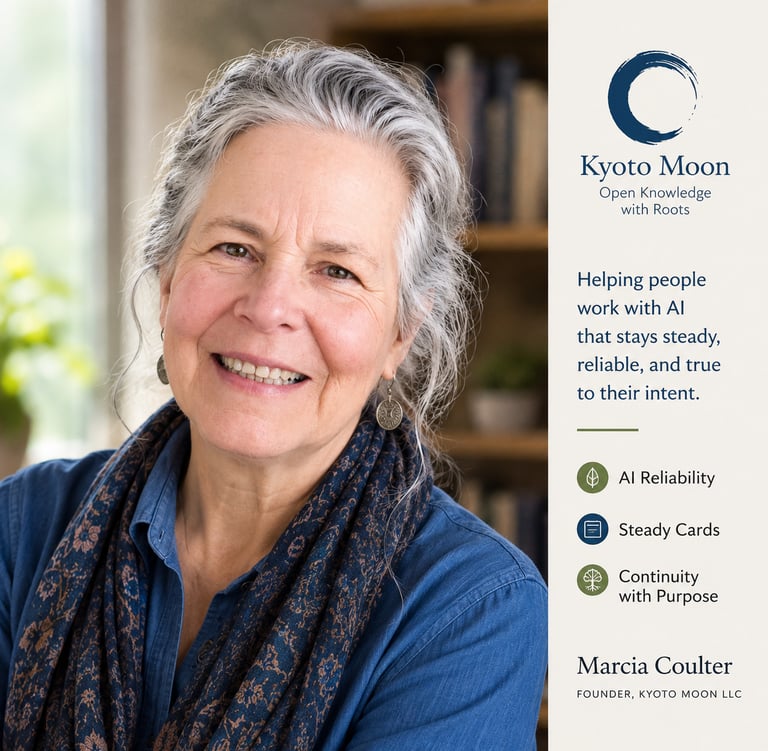
Marcia L. Coulter
Founder
Marcia L. Coulter is the founder of Kyoto Moon LLC and the originator of Steady Cards™ and Durable Reasoning Layer™.
Her background spans instructional design, technical documentation, systems analysis nd architecture, federal contracting support, workflow development, and organizational knowledge systems.
Across very different environments, she repeatedly encountered the same structural problem: Organizations lose continuity.
Knowledge disappears between drafts. Between meetings. Between software systems. Between employees. Between departments. And increasingly, between AI sessions.
Over time, this creates invisible costs:
repeated explanations,
duplicated effort,
unstable decisions,
audit difficulties,
and reasoning that can no longer be reconstructed.
Durable Reasoning grew out of an attempt to solve that problem.
Rather than treating documentation as passive recordkeeping, the work explores what becomes possible when reasoning itself is treated as a reusable operational asset.
Marcia’s approach combines systems thinking with practical workflow realism. Her work is informed not only by technology, but by long-standing interests in learning systems, provenance, organizational memory, biological systems, and the relationship between structure and human judgment.
She is particularly interested in how retrieval-based approaches may help reduce unnecessary recomputation in AI systems while improving continuity, accountability, and long-term usability.
Kyoto Moon reflects a belief that the future of AI should not be built solely around acceleration. It should also be built around durability, traceability, and responsible collaboration between people and intelligent systems.